Why a balcony vegetable garden isn’t watered like a garden
On a balcony three things pile up that a garden keeps apart: sun, wind and substrate in a small volume. The result is very fast drought on windy days and waterlogging on rainy days, with very little soil available to balance it out.
The practical consequence is that manual watering slips out of your control and the substrate behaves unevenly. That’s why here an automatic system pays off far more than in a large garden, and why the design of the zones decides whether it works.
The raised tank, the decision that changes everything
A water tank on a balcony isn’t just storage: it’s what makes drip irrigation work without a pump.
Place it raised, 30-50 cm above the level of the emitters. That height generates hydrostatic pressure, and that pressure is what makes the water reach the end emitters, the ones that are furthest away and the ones that sit highest. The difference between watering properly and watering halfway is almost always the height of the tank.
Placing the tank high also increases the system’s headroom: if the tank runs dry there is no irrigation, and that’s a fact worth keeping visible.
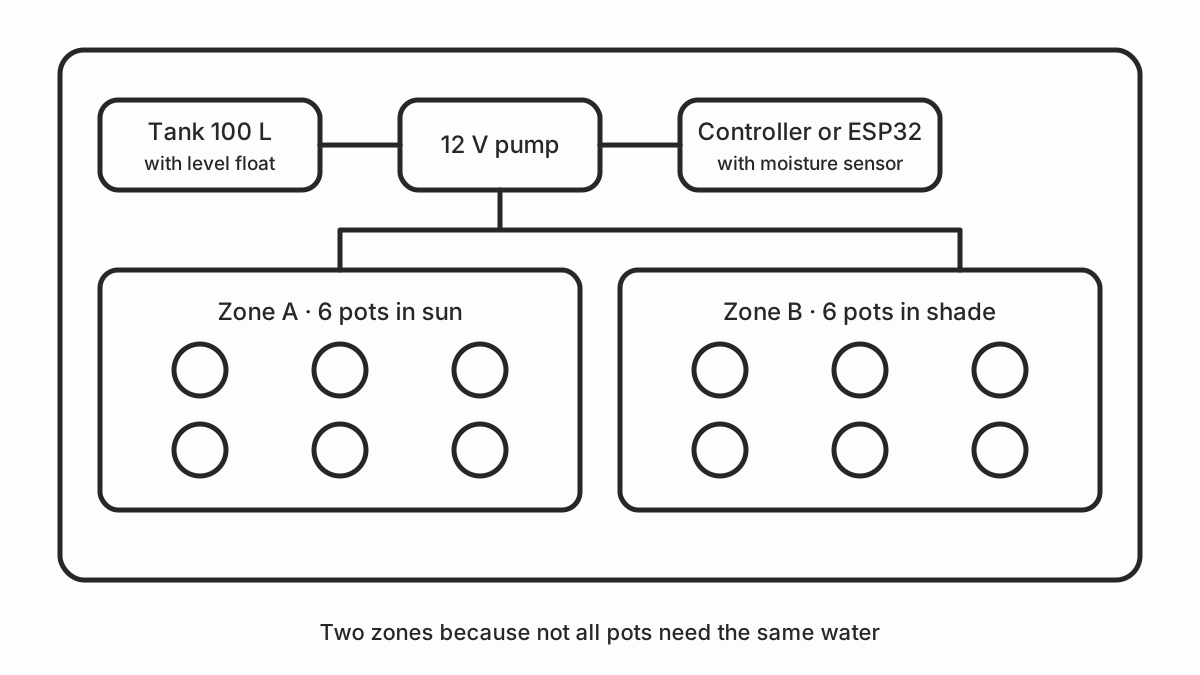
Sizing the tank and the flow rates
Start from the flow each plant needs, not from the size of the tank:
| Plant | Reference emitter | Approximate use |
|---|---|---|
| Lettuce, chard, spinach | 2 L/h | 0.3-0.5 L/day |
| Tomato, pepper | 4 L/h | 1-2 L/day in summer |
| Herbs | 1-2 L/h | 0.2-0.4 L/day |
| Shrubs in a large pot | Micro-sprinkler | 1-3 L/day |
These figures are orders of magnitude for a single potted plant, not catalogue prices: real demand depends on the substrate, the pot size and the wind, and it’s measured with the pot weight method.
Once you have the total daily use, add a 30 % margin and work out the days of autonomy: with a 50-litre tank and a consumption of 8 litres a day you have a little over six days of reserve. And if the tank sits outdoors in summer, allow for evaporation: it’s noticeable.
The technical detail of the flow rates, the spacing between zones and the drip line assembly is covered in its own article.
One zone or several: don’t use a single circuit
The most expensive mistake in a balcony vegetable garden is a single circuit for everything. Drip irrigation is sensitive to line length: an emitter at the end of a long pipe receives less water than one at the start, and that difference shows when pressures are low.
Split by what needs water in a similar way, not by what sits next to what:
- One zone for leafy greens and herbs.
- One zone for fruit, which need more flow.
- Another one for seedbeds, if you have them, with their own timer or their own line.
Each zone with its own timer or valve lets you compare behaviour: a zone that waters when the rest don’t usually has a blocked emitter or a leak. The assembly with solenoids and zones explains how to wire that separation.
The substrate matters as much as the irrigation
In a pot, pure garden soil compacts, doesn’t retain water well and ends up killing the roots. What works is a mix with components and proportions that retains available water and lets the excess drain out.
Two rules for a balcony:
- Never without perlite or vermiculite in the mix: the pot sits on top of your floor and any puddle stays there for hours.
- Fabric pots or grow bags instead of rigid pots: the fabric breathes on all sides and the roots aerate themselves.
Wind, the variable that ruins a balcony vegetable garden
A vegetable garden on a rooftop or an open balcony loses more water to wind than to sun. Two simple actions:
- Screen or windbreak: a mesh or a translucent sheet a metre and a half from the edge cuts the wind and slows it down without casting shade.
- More frequent and shorter watering on windy days, instead of a long watering that runs off the edges.
If the balcony is very small, solar irrigation can make sense, although with fewer plants the advantage is smaller than the effort.
The assembly, in order
- Defined zones by plant type and by line length.
- Raised tank 30-50 cm above the highest emitter.
- Drip line with emitters every 30 cm and the output checked with a glass.
- Timer per zone or a system with a sensor if you already master the dashboard.
- Soil sensor in the most representative and driest zone, to validate the watering.
- Tank cover against direct sun if it’s opaque.
If something isn’t watering equally well, the order of the troubleshooting guide will save you time.
Sources and next step
For water demand by crop type, see the water use guide and FAO-56; for pot substrate, the substrate and drainage article.
External sources
- FAO: Crop evapotranspiration, Paper 56 — crop water demand by climate and growth stage.
- MSU Extension: smart irrigation and soil sensors — how substrate and climate combine in irrigation.