The substrate decides more than the fertiliser
In soil, the volume of growing medium is almost unlimited and the system balances itself. In a pot you have between one and five litres of medium around the roots, and every decision you take in that mix has a direct effect on how the water reaches them.
A good substrate does four jobs at once, and if it only does two, the problem shows up within weeks:
- Retain water so the plant doesn’t dry out between waterings.
- Let the excess drain out so the roots breathe.
- Keep air in the mix, even when it’s soaked.
- Be stable, so the substrate doesn’t break down by the third season.
Drainage is half of the job, and it’s the part people forget most.
The components and what each one is for
| Component | Retains water | Aerates | Note |
|---|---|---|---|
| Peat | A lot | Little | Acidic and compacts over time |
| Coco coir | A lot | Medium | Must be hydrated before use |
| Perlite | None | A lot | Inert, doesn’t absorb water |
| Vermiculite | A lot | Medium | Retains more than perlite |
| Bark | Little | A lot | Usual base in vegetable gardens |
| Sand | None | A lot | Washed, coarse river sand |
| Expanded clay | None | A lot | Only as a drainage layer |
Peat: it’s the base of almost all commercial mixes and absorbs water at a high rate. The problem is that it compacts: after a year, the substrate in a pot has fewer air pores and the plant suffocates even if you water it just right.
Coco coir: coconut fibre widely used in mixes with peat. It retains water without compacting and keeps its structure. It’s worth hydrating and washing it before use, because it can come loaded with salts.
Perlite and vermiculite: they’re the modulators of the mix. Perlite creates voids and vermiculite retains more water and adds potassium. Perlite alone gives a substrate that dries out suddenly; vermiculite alone gives one that waterlogs.
Bark: it’s the typical substrate for vegetable gardens and fruit trees. Stable structure and plenty of aeration, but it retains little water: it needs frequent watering.
The mixes that work
Proportions by volume, not by weight:
- Small indoor pot: 1 part peat + 1 part perlite.
- Medium outdoor pot: 2 parts peat + 1 perlite + 1 vermiculite.
- Vegetable garden in a large pot: 3 parts bark + 2 peat + 1 perlite.
- Seedbeds: 4 parts peat + 1 perlite, very fine.
- Fabric pots or bags: standard pot mix, without a drainage layer at the bottom.
The logic is always the same: more structure-forming substrate in large, dry pots, more vermiculite if the watering is going to be irregular.
With a universal shop-bought substrate:
- Sieve the substrate through a 5 mm sieve to remove large pieces and twigs.
- Add perlite: one part perlite to three parts substrate is a reasonable starting point.
- Check the pH: peat is acidic. For plants that prefer a neutral pH, such as tomato and many Mediterranean herbs, a specific substrate or a pH correction settles the matter.
- Hydrate before planting: if you plant into dry substrate, the roots stay without moisture in the area closest to the stem.
Drainage: the part that decides whether the plant lives
A very common mistake is making the perfect mix and putting it in a pot without holes. All the work is lost.
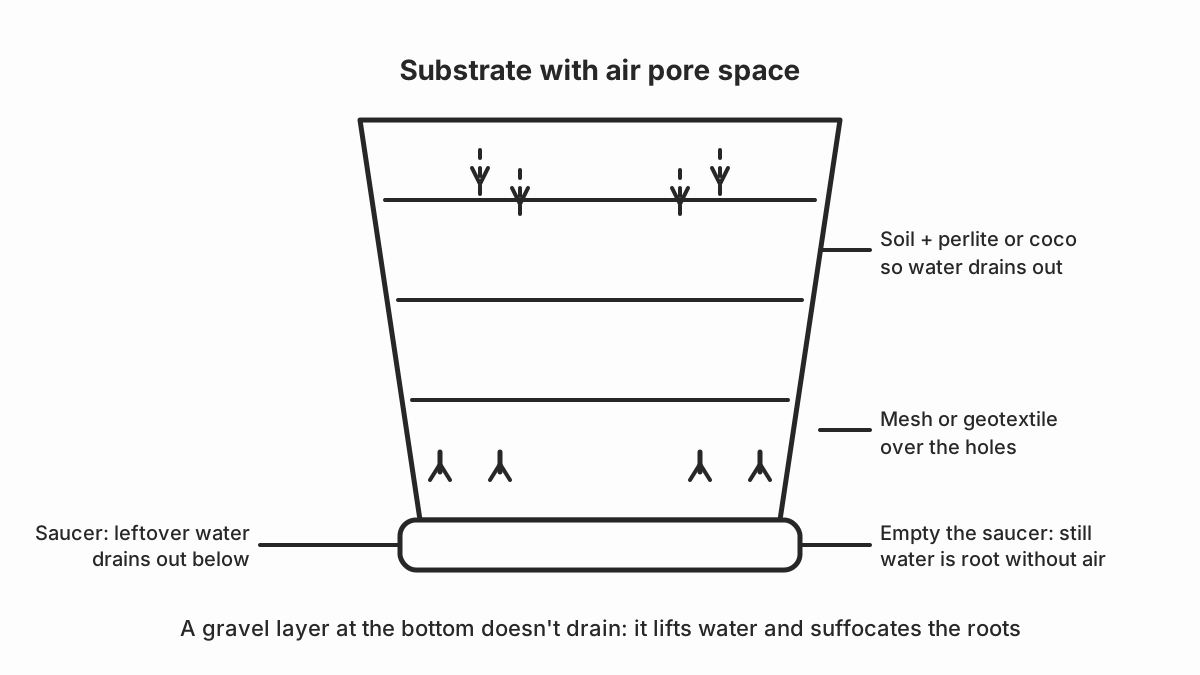
- Drainage holes always, and never blocked by a saucer that isn’t emptied.
- Drainage layer of clay pebbles or broken tiles 2-3 cm deep. Its real function isn’t to “drain”, but to separate the substrate from the bottom of the pot so the water doesn’t pool at the bottom. It doesn’t replace the holes.
- Raise the pot off the floor with feet or broken tiles: resting on a saucer, the water comes out and stays in the base.
- Never use a saucer you don’t empty. Still water at the bottom is the most common cause of root rot in indoor pots.
When to replace or repot
- Partial replacement: each season, remove the top 3-5 cm layer and replace it with fresh substrate. It’s the cheapest option and avoids a full repot.
- Repot into a bigger pot only if you see roots coming out of the holes or if the substrate has compacted and drains badly. If the plant is doing well in a 30 cm pot, it doesn’t need a 60 cm one.
- When repotting, handle the root ball by its base, never by the stem, and keep as much healthy root as possible.
Fresh substrate retains less water than the old one, so the first month calls for slightly more frequent watering. Measure it with the pot weight method.
When substrate stops being the best option
Some crops do better without substrate: in hydroponics the root floats in a nutrient solution and the water arrives directly, without soil to compact or to accumulate salts. It’s more efficient in water and nutrients, and also more demanding: you have to measure, oxygenate and maintain the solution.
If what holds you back is plant loss and root rot, before moving to hydroponics it’s usually enough to fix the substrate and drainage, which is what the section above explains.
How to check that your mix is right
- Drainage test: water thoroughly and watch how long the water takes to come out of the bottom. If it takes more than a minute, the mix is too compact.
- Weight test: the wet pot and the dry pot give different weights. That difference is your real sensor, and it’s what a soil sensor measures.
- Finger test: push a finger two centimetres in and check whether it comes out moist. It’s good for consistency, not for deciding precisely.
- Smell: a soaked substrate that smells of mould is compacted and needs changing.
Mistakes that ruin a substrate
- Reusing substrate from a sick plant: pathogens carry over. If you do, remove the fine roots and mix well.
- Adding gravel as a drainage layer: it reduces root space and doesn’t improve drainage.
- Compacting the mix when planting, as if it were garden soil.
- Using pure garden soil in a pot: it compacts and doesn’t drain.
- Covering the surface with small stones: they retain moisture and mislead you when you check substrate moisture.
Sources and next step
How container mixes behave is covered in the MSU Extension container growing guide, and the water use guide explains how substrate affects watering frequency. If your problem is water logging, start with the troubleshooting guide.
External sources
- MSU Extension: planting in containers — pot mixes, substrates and water management in containers.